
Client story · Molloy Agriculture
One system, five divisions.
How a Mid Canterbury agricultural services business grew without growing headcount, after an independent selection and an implementation e2e managed from start to finish.
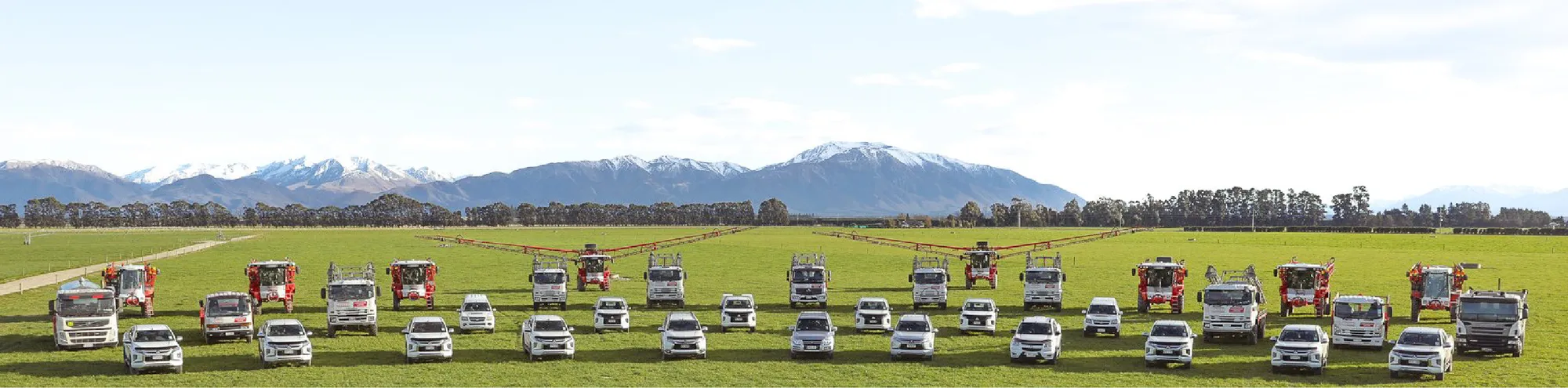
- 130,000 ha
- sprayed a year
- 40
- vehicles in the fleet
- 5
- divisions, one system
In 1985, David and Sonia Molloy started out as owner-operators with a single spray unit, a J1 Bedford. Over the next four decades they built it into one of Mid Canterbury's leading agricultural services businesses.
Today Molloy Agriculture works from its base near Methven across five divisions: spraying and application, agronomy, liquid fertiliser, Bateman sprayer sales and servicing, and agrichemical recovery. That growth brought a new challenge. Molloy had become a large, complex business, and it had reached the size where it needed an ERP system to match.
Too many systems, too much paper
Molloy was running on MYOB, Green Light Grower Management, Excel, invoice books and paper dockets. Jobs were managed through handwritten sheets, texts and phone calls, and dispatch relied on dispatchers knowing every job and every farm by heart. With more than 10,000 spray jobs a year, and over 300 a week at the October to December peak, the cracks showed.
"Everything was manual, and paper gets lost. We were losing track of stock and missing jobs. We even had jobs done twice, because the paperwork simply wasn't signed off, ended up back at dispatch and got sprayed again."
Henry Ross, General Manager
Every invoice was typed in by hand, and every department tracked things its own way. Monthly reporting meant pulling data out of the finance system and reworking it in spreadsheets. As e2e's discovery report put it at the time: "The commitment and extra efforts by the staff are making it work, but this is not sustainable."
Independent advice before any software
On the recommendation of Molloy's accountants, Croys, the business brought in e2e to take an independent look before committing to any software.
e2e ran a discovery workshop with the team at Molloy and their accountant, documented the requirements in detail for all five divisions, and managed a competitive selection process with a shortlist of vendors. It wasn't straightforward. Several larger providers passed on the opportunity, because Molloy sat at an awkward size for them.
The solution that fitted was Oracle NetSuite, with NextService for field service: finance, inventory, job management, scheduling, a mobile app for operators and CRM in one platform. NetSuite was implemented by Savvy Consulting, with e2e providing project management throughout. With no strong IT skill set in-house, having an advisor who understood the business was critical.
"The developers were based all over the world, and they didn't know New Zealand, agriculture or contracting. Having Dave Barron, who knew our business and could join the dots, was really important. He was in every meeting with us."
Henry Ross
Built by the people who use it
Implementation started in January 2023, with project meetings several times a week. Molloy's staff were at the centre of it. Schedulers, the workshop team and the admin team all helped design processes such as the spray plan and the mechanic's job sheets. The internal team cleansed the data so thoroughly that the implementation consultant said it was the smoothest data import he'd seen in 25 years.
Molloy went live on 1 August 2023. In the first month, the team sent every invoice, paid every creditor and scheduled jobs straight to drivers in the field.
"People adapt to change differently, and that was my biggest worry. But it went smoother than I expected. Without the people in the business, it wouldn't have been a success."
Operations Manager James Watts now runs all of Molloy's field service scheduling in the system, day in, day out.
Real-time visibility, from the office to the paddock
Dispatchers now see every job on a single scheduling screen: up to 100 jobs a day, and as many as 16 sprayers alongside recycling trucks and tankers. If an operator finishes early, a job can be moved to them on screen, instead of trucks heading back to base for paperwork.
When a job is finished, the farmer and agronomist get a Proof of Placement report straight away, showing what was applied, where and when.
"Customers love it. Farmers and agronomists never used to know exactly when a job was done. Now they know it finished at 2:27 that afternoon, so they can plan the next application."
Invoicing follows within days, and Molloy has now moved to automatic invoicing and statements.
"I can see live information as it happens: who owes us money, what's in stock, what's on order, how we're tracking against budget. It's all there."
- Grew the business without growing headcount
- Month-end reporting that took days is now largely automated
- Stock takes close to 100% accurate
- Proof of Placement reports sent as soon as a job is complete
- Automated invoicing and statements
- One system across five divisions and around 2,000 customer accounts

A platform for the next stage
The system is built to handle many times Molloy's current volume, opening up options such as bringing another contractor into the business without adding admin.
"The first twelve months you're a bit sceptical about whether you're getting a return. Now you just wouldn't go back."
"When you're flat out, that's when you get slippage. If everything's loaded and scheduled up front, you can see your stock and your pricing is correct. It's a big cost, but it's an investment. Get through the first couple of years and you start seeing the benefits."
"I was really nervous about putting in an ERP system. You hear of so many failures. I didn't need to worry. I truly believe having e2e support and guide us is why we delivered a great project for the right price."
Henry Ross, General Manager, Molloy Agriculture
Read or share the two-page version of this story.
Considering a new system?
Start with a conversation. Thirty minutes, no slides, and we'll tell you honestly whether you need us.